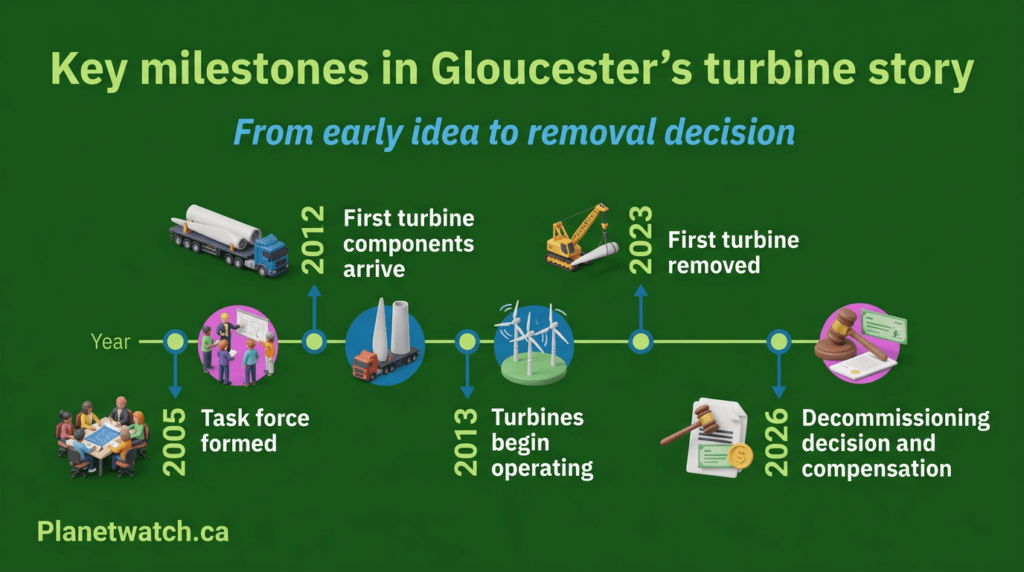
Two wind turbines on Gloucester’s shoreline are scheduled to come down, and with them the city loses a dependable stream of municipal revenues, a visible commitment to clean energy funding, and a live experiment in local wind power economics.
For more than a decade, two of Gloucester’s three turbines supplied electricity under a 25 year power purchase agreement. They offset roughly half to more than two thirds of municipal energy use and delivered a direct financial return to the city budget.
Gloucester received 20 percent of the money the spinning blades generated each year. That share started at about 100,000 dollars and later climbed to 478,000 dollars, quietly supporting services that residents rely on without raising property taxes.
The turbines will now be decommissioned so their private owner can expand industrial operations on the same land. In exchange for ending the agreement early, Gloucester will receive a one time compensation payment of 587,000 dollars.
That payment helps, but it does not replace a recurring clean energy funding source that could have continued for another 12 years. Once the cheque is spent, the city still needs to power buildings, maintain infrastructure, and find room in the budget for climate action.
The loss is financial, but also symbolic. The towers had become part of the skyline, a daily reminder that a working port city could also back renewable power. Some residents saw them as proof that local government could make modern investments without abandoning tradition.
Opponents point to downtime, maintenance challenges, and the early shutdown as evidence that wind power does not work. The numbers tell a different story. Over 13 years, the turbines reduced municipal energy costs and generated hundreds of thousands of dollars for public use while regional clean energy capacity kept growing.
The economic impact of turbine removal in Gloucester highlights a choice facing many municipalities. Short term development pressures and one off compensation payments are easy to quantify. Long term revenue from wind power, and the confidence it gives communities to pursue bolder climate goals, is harder to price.
For young climate minded residents, educators, and local leaders, the lesson is clear: track the cash flows, not just the controversy, and make sure the next clean energy project locks in both emissions cuts and durable municipal revenues.
#cleanenergy #windpower #municipalfinance #Gloucester #climateaction
If you haven’t already and you do care about climate change, sign up for the Planet Watch newsletter.
This post was created by a human editor in collaboration with an AI-assisted Draiper ContentFlow workflow.
References:
My city’s two wind turbines are shutting down. Here’s what we’re losing.
.DraiperAuthor-Container { display: flex; align-items: stretch; width: 100%; margin: 0 auto; } .DraiperAuthor-ImageDiv { flex: 0 0 120px; min-height: 120px; position: relative; overflow: hidden; display: flex; align-items: flex-start; justify-content: center; } .DraiperAuthor-ImageDiv::before { content: ”; position: absolute; top: 0; left: 0; width: 100%; height: 100%; z-index: 1; } .DraiperAuthor-Image { width: 120px; height: auto; position: relative; z-index: 2; background-color: #E8E8E8; border-radius: 50%; } .DraiperAuthor-TransparentCircle { position: absolute; top: 50%; left: 50%; width: 120px; height: 120px; background: transparent; border-radius: 50%; transform: translate(-50%, -50%); z-index: 3; } .DraiperAuthor-InfoDiv { display: flex; flex-grow: 1; flex-direction: column; justify-content: center; padding-left: 20px; } .DraiperAuthor-Name { font-size: 18px; font-weight: bold; margin-bottom: 6px; } .DraiperAuthor-JobTitle { font-size: 14px; font-weight: bold; line-height: 1.5; } .DraiperAuthor-Bio { font-size: 14px; line-height: 1.5; }